How to become a surrogate and get paid
To become a surrogate, confirm you meet the surrogate requirements, then apply free to a reputable agency or clinic in your state. Applying costs nothing and screening takes a few weeks. Start with your state below, or jump straight to a top-paying market:
Free to apply. Not an offer of employment and not a guarantee of income.
Can you be a surrogate? Take the 30-second check
Seven quick questions. We check your answers against the published requirements of the surrogacy and egg donation programs we work with, then show the program that fits you best.
How old are you?
Most surrogacy programs accept women about 21 to 40, and a few go a little older.
Do you have at least one child of your own?
Having given birth before is a standard medical requirement for surrogacy.
What is your BMI?
Each program has its own BMI limit. Not sure? Use the last option and we will work it out from your height and weight.
Are you a non-smoker?
Programs require surrogates and egg donors who do not smoke.
How many times have you been pregnant?
Count every pregnancy, including any that did not go to term.
Are you a U.S. citizen or permanent resident?
Which state do you live in?
Disclosure: EggDonorPay may earn a referral fee if you apply to a program through our links, at no cost to you. It never changes your compensation. This check is a quick guide to published program requirements, not a medical evaluation or a guarantee of acceptance. Each program makes its own final decision, including medical and background screening. We are not an agency.
Surrogate pay map: all 50 states
Tap any state to open its full local breakdown. Colors show relative demand tiers; the data behind the map is in the table below.
Embed this map on your site (free)
This interactive pay map is free to embed on any site with attribution. Paste the code below into your article or resource page. The map stays current on its own: we refresh the underlying pay data monthly, so your embedded copy updates automatically. Please keep the source line under the map so your readers know where the data comes from.
All 50 states compared
| State | Typical base compensation (2026) |
|---|---|
| Alabama Mid | $40k–$55k |
| Alaska Mid | $45k–$60k |
| Arizona Mid | $45k–$62k |
| Arkansas | $40k–$52k |
| California High | $55k–$75k |
| Colorado Mid | $48k–$65k |
| Connecticut High | $50k–$68k |
| Delaware Mid | $45k–$60k |
| Florida High | $48k–$65k |
| Georgia Mid | $45k–$62k |
| Hawaii Mid | $48k–$63k |
| Idaho | $40k–$55k |
| Illinois High | $50k–$66k |
| Indiana Mid | $42k–$56k |
| Iowa | $40k–$54k |
| Kansas | $40k–$54k |
| Kentucky | $40k–$54k |
| Louisiana | $40k–$54k |
| Maine Mid | $44k–$58k |
| Maryland High | $50k–$66k |
| Massachusetts High | $55k–$72k |
| Michigan Mid | $45k–$60k |
| Minnesota Mid | $47k–$63k |
| Mississippi | $38k–$52k |
| Missouri Mid | $42k–$56k |
| Montana | $40k–$54k |
| Nebraska | $40k–$54k |
| Nevada Mid | $46k–$62k |
| New Hampshire Mid | $46k–$61k |
| New Jersey High | $52k–$70k |
| New Mexico | $40k–$54k |
| New York High | $55k–$75k |
| North Carolina Mid | $45k–$60k |
| North Dakota | $40k–$54k |
| Ohio Mid | $44k–$59k |
| Oklahoma | $40k–$54k |
| Oregon Mid | $48k–$64k |
| Pennsylvania Mid | $47k–$63k |
| Rhode Island Mid | $46k–$61k |
| South Carolina Mid | $42k–$56k |
| South Dakota | $40k–$54k |
| Tennessee Mid | $42k–$56k |
| Texas High | $48k–$65k |
| Utah Mid | $44k–$58k |
| Vermont | $44k–$58k |
| Virginia Mid | $47k–$63k |
| Washington High | $50k–$68k |
| West Virginia | $38k–$52k |
| Wisconsin Mid | $44k–$59k |
| Wyoming | $40k–$54k |
Ranges are 2026 estimates built from agency data, demand, and cost of living. Your actual offer depends on the agency, your profile, and your state's surrogacy laws, and your experience. Confirm current figures with the agency. "High/Mid" badges reflect relative demand tiers. Tap a state name for the full local breakdown.
Which states pay the most?
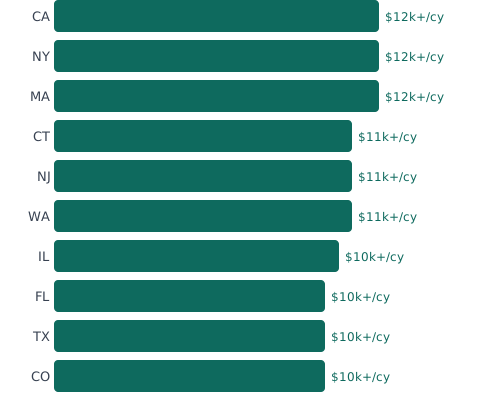
California, New York, Massachusetts, New Jersey, Illinois, Washington and other high-cost, high-demand states consistently pay at the top. Surrogacy pay is also shaped by how favorable each state's laws are. Surrogacy-friendly states like California, Illinois, Nevada, Connecticut, and Washington tend to pay more and have more agencies operating.